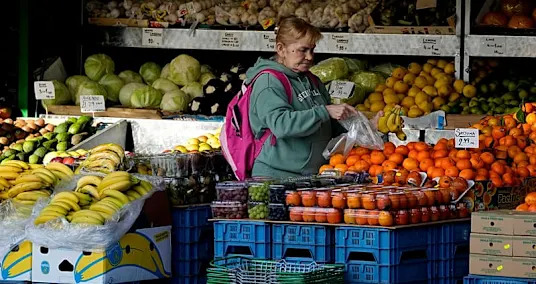
The joint US–Israeli strikes on Iran and Tehran’s response have pushed oil prices higher, with Brent crude frequently rising above $100. Experts say this will affect not only energy prices but also food prices.
The impact could be particularly strong in Europe, leading to higher food costs and a rising cost of living.
So, how will the crisis in the Middle East affect food prices across Europe? Which countries are more vulnerable and why?
Experts talking to Euronews Business point out that the crisis is expected to push global food prices higher through multiple channels.
"Global, as well as European, food prices are expected to rise because of the conflict due to the disruption of fertiliser and energy supply, as well as rising shipping costs,” Zsolt Darvas, senior fellow at Bruegel, told Euronews Business.
He emphasised that a large share of the world’s fertiliser and oil supply moves through the Strait of Hormuz, which has been effectively shut down due to the war.
Higher fertiliser costs translate directly into higher agricultural production costs.
Oil and LNG prices have already increased significantly, and higher fuel costs affect the entire food chain, raising production costs and shipment.
How will the situation evolve?
Significance of fertiliser
The United Nations Food and Agriculture Organization (FAO) reports that global fertilizer prices are projected to average 15–20 percent higher in the first half of 2026 if the crisis persists.
Maximo Torero, the FAO chief economist, noted that rising fertiliser and energy costs increase production expenses for farmers, and lower input application could result in reduced crop yields later in the year, tightening global grain supplies.
The FAO Food Price Index has already begun to rise again after a period of relative stability.
“While European natural gas prices surged 50–75 percent in the first weeks of the crisis, and higher energy costs increase costs across agricultural supply chains—including farm operations, irrigation, transport, storage, and food processing—these pressures will eventually transmit to consumer food prices,” Torero told Euronews Business.
The FAO cautions that if farmers cut fertiliser use due to high costs, future harvests may shrink, leading to tighter grain supplies and a surge in food prices later in 2026.
Three main channels driving food inflation across Europe
The FAO identifies three primary transmission channels through which the crisis could drive food inflation in Europe. Torero explained that energy costs are the first pressure point.
The Persian Gulf is a critical supplier of refined fuels, and disruption to those supplies has pushed diesel and jet fuel prices higher, increasing transportation and logistics costs throughout the food supply chain.
LATEST POSTS
- 1
 How color-changing, bacteria-infused spacesuits could help keep future astronauts safe from space radiation
 - 21st human missions to Mars should hunt for signs of life, report says
- 3From Loner to Force to be reckoned with: Individual Accounts of Change
- 4Winter storms blanket the East, while the U.S. West is wondering: Where’s the snow?
- 5Merz postpones Norway trip for Belgium talks on frozen Russian assets


- Which camera do you believe is great for first-time clients? !
- Jason Kelce opens about wife Kylie Kelce's past pregnancy loss
- Damaged launch pad: How long before Russia can send astronauts to the ISS again?
- Instructions to Shield Your Gold Speculation from Possible Dangers: Fundamental Protections
- SpaceX launches Starlink satellites on its 150th Falcon 9 mission of the year
- Would you ever turn to AI for companionship? 6% of Americans say they could — or already have.
- Sa'ar warns German delegation: 'A Palestinian state would be a Hamas terror state'
- 5 Advancement Developments in Biotechnology
- The most effective method to Boost Benefits in Gold Speculation: Master Techniques and Tips


